

How to improve the payment experience when selling travel
 Written byMOGU Team
If you sell travel, this will sound familiar: the client confirms, pays a deposit and, two weeks later, changes a room, another traveller joins, an activity is added or a date has to move. Collecting the first payment was easy. The hard part is keeping the financial status of a booking that keeps changing coherent, without having to rebuild it from emails, spreadsheets, bank movements and the operation itself every time you need to check it.
That is why, when we talk about the payment experience in travel, the checkout is only the visible layer. Underneath, there should be an architecture able to relate booking, buyer, travellers, services, due dates, transactions, adjustments and refunds. For the client, that architecture translates into clarity. For you, into something more important: being able to read the real financial position of the trip at any moment without reconciling it by hand.
The payments landscape is also changing. In 2024, 21% of everyday consumer payments in the euro area were already made online, accounting for 36% of total value. The European Central Bank thus confirms a trend you already know from the industry: more and more decisions and transactions happen remotely, including when the amounts are significant.
The quality of a payment is therefore decided on two levels: how easy it is to complete the transaction, and how much context that transaction keeps as the booking moves forward. In travel, improving only the first leaves much of the work untouched.
Payment is part of the booking, not an isolated step
Before the client enters a card or logs in to their online banking, the system should already have settled what is being bought, which version of the booking is being confirmed, what amount is due now and what obligations remain afterwards. That information is not decorative: it is the context that will allow the payment to be interpreted correctly later on.
If you work with configurable trips, you already know that the final price is not an isolated figure but the result of a specific combination of services, categories, travellers and conditions. The checkout should receive that configuration already closed and charge against it, not reinterpret the trip. The more you separate building the booking from collecting payment, the easier it is for differences to appear between what was sold and what was paid.
After the payment, the reverse process takes place: the transaction has to write back to the booking. Receiving a "paid" is not enough. The system should update the balance, the status of the instalment and the traceability of the payer, and keep the identifier that allows a future refund or incident to be linked to the original transaction. This is where a payment stops being a financial movement and becomes a booking event.
When that link breaks, two versions of the truth appear: the commercial one, what you think is booked, and the financial one, what has actually been collected. The cost is not only administrative. It also affects operational decisions: confirming a supplier, releasing a place or chasing an instalment depends on both versions matching.
A well-designed collection architecture keeps those two layers in sync. That is why a good payment experience is not measured only in conversion, but also in the ability to answer, without side calculations, what has been contracted, what has been collected and what financial exposure remains open.
Why collecting payment for travel takes more than a payment gateway
As you already know, in travel the time between purchase and delivery completely changes the logic of collection. The money comes in while the product can still evolve and while you start taking on commitments with third parties. That is why the system needs to keep history: what was sold at each moment, what amounts were collected against that version and what changes later altered the balance.
The difference matters because a modified booking should not erase its previous financial snapshot. If the amount changes, the right thing to do is to generate a new obligation or an adjustment to the balance, keeping the earlier payments intact. Overwriting the total may leave the final figure correct, but it removes the traceability you need to explain how you got there.
The payment schedule is also an operational decision
On many trips the payment schedule should be designed alongside the schedule of commitments. Before the client settles the total, you may already have paid deposits, confirmed allotments, hit non-refundable dates or taken on costs that can no longer be recovered.
This is where a variable appears that is often treated separately from the checkout: cash exposure. If the percentage collected from the client systematically stays below the money you have already committed to suppliers, growth starts to consume working capital. If you set it too high and too early, you pass too much friction on to the client. The payment plan has to balance conversion, cancellation risk and real treasury needs.
A well-designed schedule starts from financial milestones, not arbitrary dates: what amount confirms the booking, which costs become committed from each date, when the cancellation policy changes and what balance you need covered before taking the next operational step. That logic should live inside the booking so that sales, operations and finance work to the same criteria.
Splitting the price into several instalments is not the same as financing the purchase; it is still a commercial schedule. The difference lies in managing it as part of the trip's financial architecture: each instalment has an amount, a date, a status and a relationship to the booking. When one of those elements changes, the system should keep the history instead of forcing you to rebuild it afterwards.
Buyer, traveller and payer are not always the same person
In groups it pays to separate three roles that are often mixed up: who books, who travels and who pays. They may coincide, but not always. And when they do not, the system needs to keep the relationship between them, because the balance of the booking and the balance of each participant do not mean the same thing.
If you manage group travel or MICE projects, that distinction lets you work on two levels of reading: the overall financial position of the trip and the individual position of each buyer or traveller. A payment can reduce the total balance without settling every participant, or cover several travellers at once. Without that hierarchy, reconciliation ends up moving to Excel.
This requires more than storing the payer's name. Each transaction should be able to answer which obligation it settles: an instalment of the booking, a specific place, a supplement or an added service. It is that relationship, and not the mere record of the income, that allows balances, reminders and reconciliation to be automated.
The architecture gets even more complicated when you sell in several markets. In the second half of 2025, cards accounted for 57% of non-cash transactions in the euro area and credit transfers for 21%. In air transport, IATA also shows how preferences are fragmenting: cards still dominate at 72%, while digital wallets rose to 28% and instant payments to 8% in 2025.
To decide which methods to offer, client preference is only one variable. Acceptance cost, settlement speed, currencies, the ability to automate later collections, refund handling, dispute risk and how easily each transaction returns reconciled to your system also matter. In travel, the most convenient method at checkout is not always the most efficient one for the operation.
What a payment experience built to convert and operate must deliver
An experience built to convert and operate needs to preserve context end to end. The checkout should receive an already defined booking, show the financial commitment clearly and return a result that updates that same booking. If any of those three connections fails, manual work appears sooner or later around the payment.
Baymard has spent years observing the relationship between complexity and abandonment in ecommerce. Its benchmark places 63% of the mobile checkouts analysed at a "mediocre" experience or worse, and its research finds that around 17-18% of shoppers have abandoned a purchase because the process was too long or complicated. In travel, the useful takeaway is not to cut fields without criteria, but to separate the data needed to close the transaction from the data that will be needed later to operate the trip.
That principle lets you design the flow in layers. At the moment of payment you need to identify the payer, validate the booking, confirm the amount and collect only the information essential to complete the purchase. Passports, operational preferences or documentation that do not yet condition the payment can come later, as long as the system keeps a single file. It is not about asking for less information, but about asking for it when it adds value.
If you work with instalments, the schedule should behave as a sub-record of the booking: expected amount, due date, status, the payment that settles it and the remaining balance. This structure seems minor, but it is what allows reminders to be automated, real late payment to be detected and a booking change not to turn follow-up into a manual sum of movements.
Then there is the payment method. The expansion of instant transfers in Europe does not just add another way to get paid: it introduces settlement in seconds, 24/7 availability and payee verification in the euro area. For certain amounts it can change the balance between speed, cost and reconciliation. The key is to integrate it without creating a circuit parallel to the card one.
Trust is also architecture, not just design. The amount the client sees, the payee, the reference, the conditions and the later confirmation have to tell the same story. If the proposal shows one thing, the gateway another and the confirmation email a third, friction is not solved with a prettier checkout.
A solid payment experience therefore achieves two results at once: it reduces friction for the traveller and leaves a financial structure the team can use. If it improves the first at the expense of the second, you have only shifted the work from the client to operations.
What happens after payment is also part of the payment experience
A payment experience does not end when the transaction is authorised. From there a second phase begins, less visible to the client but decisive for the operation: managing statuses, due dates, retries, adjustments and refunds without losing the link to the booking. A payment can be pending, paid, failed, retried, partially refunded or cancelled while the trip keeps its own commercial and operational status. The quality of the system shows in how it coordinates both logics, not only in how it handles the initial payment.
IATA found in its 2025 survey that 17% of travellers who tried to buy an additional service could not complete the purchase because the first method failed and no alternative was available. The figure comes from the airline environment, but it illustrates something important: a failure should not be a dead end. The architecture has to keep the pending obligation and allow it to be recovered without duplicating the booking or losing the history of attempts.
The same criterion applies to measuring the real cost of payment. IATA estimates that airlines processed around 977 billion dollars in payments in 2024 at a cost of 22.2 billion. Roughly 80% was fees, and the rest operational costs, systems, fraud and cash flow. Although the figure belongs to air transport, it leaves an idea that applies to the rest of travel: optimising payments is not only about improving conversion; it is also about reducing the cost of accepting, managing and reconciling money.
Changes, refunds and traceability
With changes and refunds, the rule should be not to erase history. The original payment, the booking modification, the adjusted amount and the refund are distinct events and should stay linked. That way you can rebuild the balance without depending on the last saved figure and keep a traceability that is useful for the client, finance and internal control.
This traceability also has sector-specific implications. If you sell package travel subject to European regulation, in certain cases of termination the organiser must make the refund without undue delay and, at most, within 14 days. Meeting that deadline depends less on knowing how to make a technical refund than on identifying precisely what was collected, what must be returned and who made each payment.
Reconciliation should rely on stable identifiers, not on a human reading of the bank reference. Booking, due date and transaction need an unambiguous relationship so that an incoming payment can automatically update the right balance. The more volume you handle, the more expensive it becomes for that match to depend on names, approximate amounts or the team's memory.
The result should look like a small ledger for the booking: contracted amount, payments made, future due dates, incidents, adjustments and refunds, all traced on the same file. It does not replace accounting, but it does spare sales, operations and finance from having to reconstruct what happened before they can work.
How to assess the payment experience you have today
Before introducing improvements, separate three levels that tend to get mixed up: the experience the client has, the logic by which you decide what to collect and when, and the work your team needs to keep the booking's financial status up to date. You can have an attractive checkout and still reconcile by hand; or impeccable internal traceability and a payment flow that causes abandonment. Assessing well means looking at all three layers.
Open a booking with partial payments and check whether you can rebuild its position without doing sums outside the system: current total, money actually collected, outstanding balance, upcoming due dates, failed payments, adjustments and refunds. Then check whether each figure can be explained back to the transaction or change that originated it.
The second test is organisational. That reading should be the same for sales, operations and finance, even if each profile sees a different level of detail. If each area keeps its own interpretation of the balance, the problem is not the gateway: it is the information architecture around it.
Month-end offers an especially useful check. Finance should be able to identify open amounts, upcoming due dates, failed payments and refunds without asking sales what each movement means. And sales should be able to tell whether a booking is financially up to date without logging in to the bank. That autonomy is a far more reliable indicator than how the checkout looks.
Then measure internal friction, not just transactions. Count how many interventions a booking needs from the moment the first payment is generated until it is financially closed: reconciliations, reminders, balance corrections, searches for transfers or checks between systems. If those tasks grow at the same pace as bookings, digitalisation has stopped at accepting the payment. A mature architecture should reduce manual interventions per booking as you standardise the process.
That is the useful criterion: the team steps in when a commercial or operational decision has to be made, not to identify money, recalculate balances or rebuild a booking's history.
How to improve the payment experience when selling travel
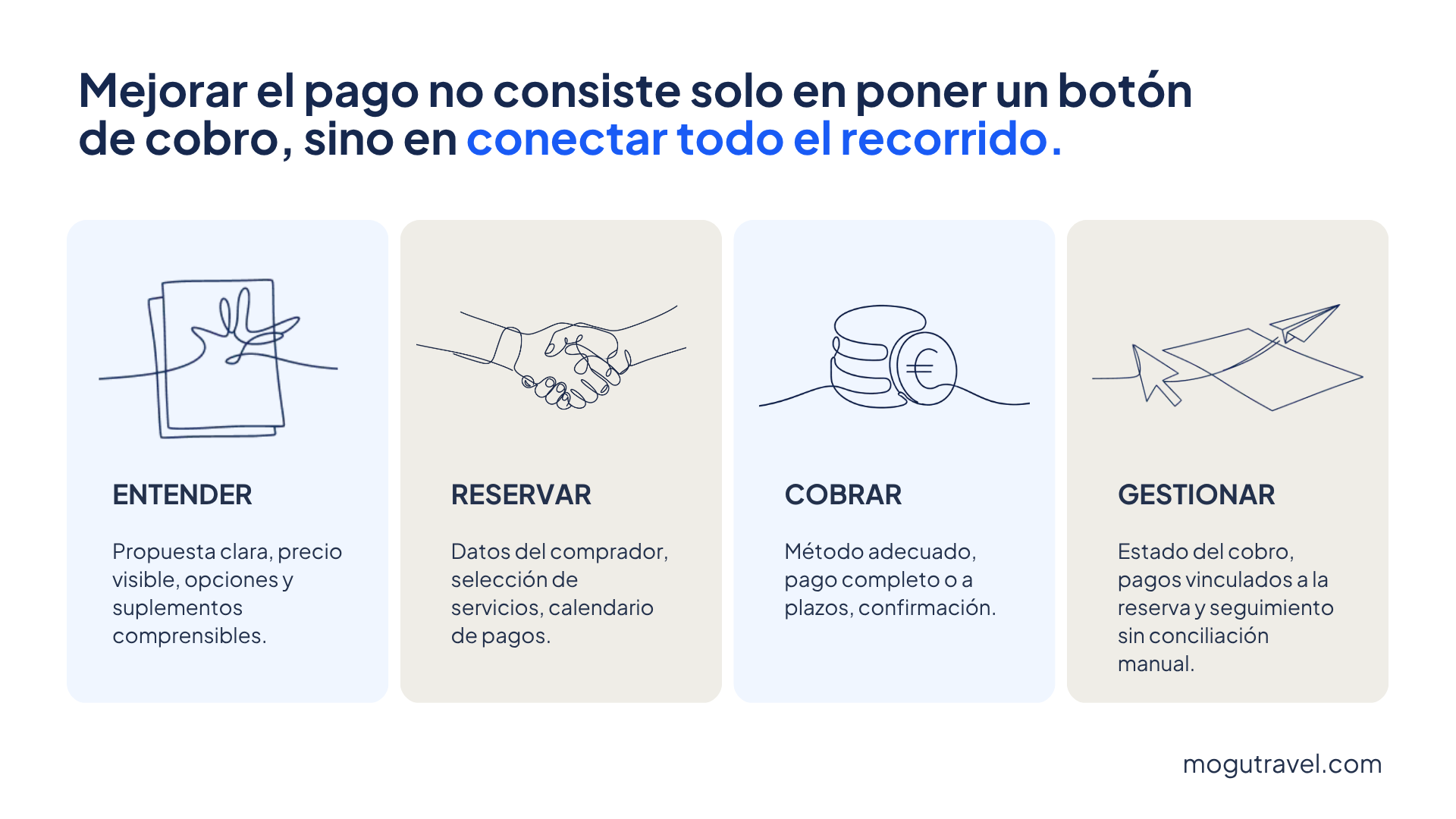
Once you have identified where the process breaks, the improvement comes from acting on the whole architecture, not only on the payment screen. The goal is for the client to meet less friction and, at the same time, for each transaction to leave a booking that is easier to manage. That means coordinating product, financial schedule, payment method and operation.
Design payment from the booking, not from the gateway
The first improvement is to reverse the usual design order. Do not start by asking what the gateway can do; start by defining what financial obligation arises from the booking. The amount, the payer, the services included, the conditions and the due date should exist before the payment is generated. The gateway executes that obligation, but it should not have to reconstruct it.
This has an important technical consequence: each payment needs a stable reference linking it to the booking and, where one exists, to the specific instalment it settles. That way, when the provider returns a confirmation, a failure or a refund, the system knows which status to update. Without that relationship, automation ends up depending on references, amounts or manual identification.
This distinction separates payment processing from payment orchestration. Processing means moving the money. Orchestrating means deciding what is collected, when, by which method, what happens if it fails and how the result returns to the operation. For a travel business, the second layer is what stops every payment method from opening its own management circuit.
Reduce friction without emptying the process of information
Improving the experience does not mean turning every checkout into three fields. In travel, some data is needed to confirm a booking and other data only starts to add value once the trip enters operation. Mixing them increases friction and makes the moment of purchase carry needs that belong to another phase.
The improvement is to design progressive collection. At payment you need to correctly identify the buyer or payer, validate the amount and collect whatever conditions the purchase. Traveller documentation, operational preferences or certain service data can be added later if they do not affect the purchase. The requirement is that everything keeps feeding the same file.
This logic also improves data quality. When information is requested too early, the client is more likely to leave it incomplete, enter placeholder values or have to correct it later. Asking for each piece of data when it is already needed reduces friction, but it also spares the team cleaning and updating work.
Make the payment schedule reflect the real economics of the trip
An effective payment schedule should not be built just because a 30/40/30 split is easy to communicate. As you already know, each trip has its own financial milestones: deposits, the start of cost commitments, changes in cancellation policy, allotment confirmations or dates after which certain services stop being refundable.
Improving the experience means translating those milestones into a schedule the client can understand without losing sight of your exposure. When the due date has a recognisable logic, the client better understands what they are confirming; when it is tied to your real commitments, the business avoids systematically financing a growing part of the operation.
It is also worth distinguishing flexibility from improvisation. Being able to change a due date or add a new payment is useful, but the system should record the reason and keep the previous sequence. That way, a commercial change does not destroy the historical reading of the booking.
Design for failure too, not just the successful payment
Payment flows are usually built around the happy path: the client pays, the transaction is approved and the system moves on. But a mature experience needs to define what happens when the operation does not end well.
If a payment fails, the financial obligation should stay open and clearly identified. The client should be able to retry or use another method without starting from scratch, while you keep the history of attempts and the outstanding balance. If what fails is a later instalment, the system should distinguish between a cancelled booking and an active booking with an unpaid instalment; they are not the same status and should not trigger the same response.
Communication comes into play here too. A payment reminder is more effective when it does not just say a debt exists but identifies the trip, the due date and the next step. Automation adds value when the message comes from the real status of the booking and not from an external diary kept by the team.
Turn the booking's financial status into a single source of truth
The most important improvement comes when sales, operations and finance stop working with different interpretations of the same trip. They do not need to see exactly the same screen, but they do need to start from the same financial information: contracted amount, money collected, open balance, upcoming due dates, incidents, adjustments and refunds.
That requires distinguishing between the gateway, which executes movements, and the booking, which gives them meaning. The first may know it has received 850 euros; the second should know which trip they cover, which obligation they settle, who paid them and what balance remains afterwards. That meaning is what allows you to automate without losing control.
When this layer is well resolved, customer service improves too. Any authorised team member can answer about a payment without rebuilding the file or depending on whoever made the sale. The client gets a consistent answer and the team avoids a financial query turning into a search across departments.
Taken together, improving the payment experience means optimising five things at once: clarity for the client, the financial logic of the schedule, the ability to recover from failures, traceability of every movement and a single reading of the booking's status. If an improvement only makes the checkout prettier or shorter, it is probably acting on the least complex part of the problem.
MOGU: payments connected to sales and operations
MOGU builds payments around the booking, not as an independent layer. The proposal can move on to booking and payment while keeping the selected options, the buyer, the travellers and the contracted services related, so the commercial information does not have to be rebuilt when you start collecting.
From that same booking you can work with full payment or several instalments, generate links tied to the file and create new payments when supplements or additional services appear. Statuses stay linked to the trip, which lets you read the balance and history from the context in which the sale took place.
MOGU currently works with Stripe, Redsys and Inespay, three options that suit different operations. Stripe allows card payments across multiple markets and currencies; Redsys connects the virtual POS of Spanish banks for businesses operating in Spain; and Inespay adds online bank transfer through open banking in Spain, Portugal and Italy.
The choice will depend on your market, your amounts and the way you want to structure collection. What matters is that this decision does not fragment later management: whichever the method, the result has to return to a specific booking and update its financial status.
That is the value of a cross-cutting payments layer: not eliminating the complexity inherent in groups, instalment payments or later changes, but stopping each of them from opening a different circuit of follow-up, reconciliation and internal communication.
Improving the payment experience in travel is not just about shaving seconds off the checkout. It is about designing an architecture where the booking keeps its financial context from the first deposit to closure: what was contracted, what was collected, what changed, what was refunded and what is still pending.
When that information travels with the booking, payment stops being an isolated transaction and becomes a useful part of the operation.
More from the MOGU blog
Keep reading

10 group travel management mistakes that eat into your agency's margin
The 10 operational mistakes that cost an agency the most time, control and margin on group trips, and how to avoid them with a connected process.
2026-10-06

MOGU Travel CRM: sales and trip management, now connected and powered by AI
Discover MOGU Travel CRM for travel agencies: centralize contacts, opportunities and trips, and automate your sales pipeline with AI.
2026-09-29
.png)
Common Group Travel Mistakes and How to Avoid Them
Discover the most common mistakes when organising group trips and learn how to improve profitability, payment collection and agency operations.
2026-06-25
Curious about MOGU?
See it in action — no strings attached