
.png)
Common Group Travel Mistakes and How to Avoid Them
 Written byMOGU Team
Group travel
is one of the most profitable product lines for many travel agencies — but also one of the most complex to manage. The more travellers involved, the greater the volume of information, documentation, payments, communications and coordination the team must handle.
From an operational perspective, a group trip can be defined as a travel product that requires the simultaneous management of multiple travellers, multiple suppliers and multiple administrative processes within a single commercial operation.
This complexity means that small mistakes can generate financial losses, operational delays, supplier issues and a poorer experience for the end client.
Most common group travel mistakes in agencies do not arise from a lack of travel industry knowledge. They emerge because internal processes stop scaling when volume increases.
Understanding these mistakes and putting the right systems in place to prevent them enables agencies to increase profitability, reduce administrative work and improve traveller satisfaction.
Why group travel management differs from individual travel management
Organising individual travel typically centres on a single client, a single booking and a single communication thread.
Group travel, by contrast, requires the simultaneous coordination of:
- Participants with different needs.
- Partial and final payments.
- Accommodation bookings.
- Transport bookings.
- Required documentation.
- Last-minute changes.
- Ongoing communication with travellers.
- Coordination with multiple suppliers.
For this reason, operational efficiency becomes just as important as the commercial ability to sell the trip.
How operational mistakes affect agency profitability
An operational mistake does not always generate a visible loss of revenue, but it almost always generates hidden costs.
These costs appear in the form of:
- Additional administrative hours.
- Duplicated tasks.
- Internal rework.
- Repetitive traveller queries.
- Claims and complaints.
- Delayed payment collection.
- Incidents during the trip.
The real profitability of a group trip depends on the commercial margin as much as on the efficiency with which every process is managed.
The main mistakes when organising group trips
Mistake 1: Not centralising trip information
One of the most common problems is storing information across multiple different systems.
Emails, spreadsheets, shared documents and messaging applications generate scattered data.
When information is not centralised, coordination errors appear, data gets lost and follow-up becomes difficult.
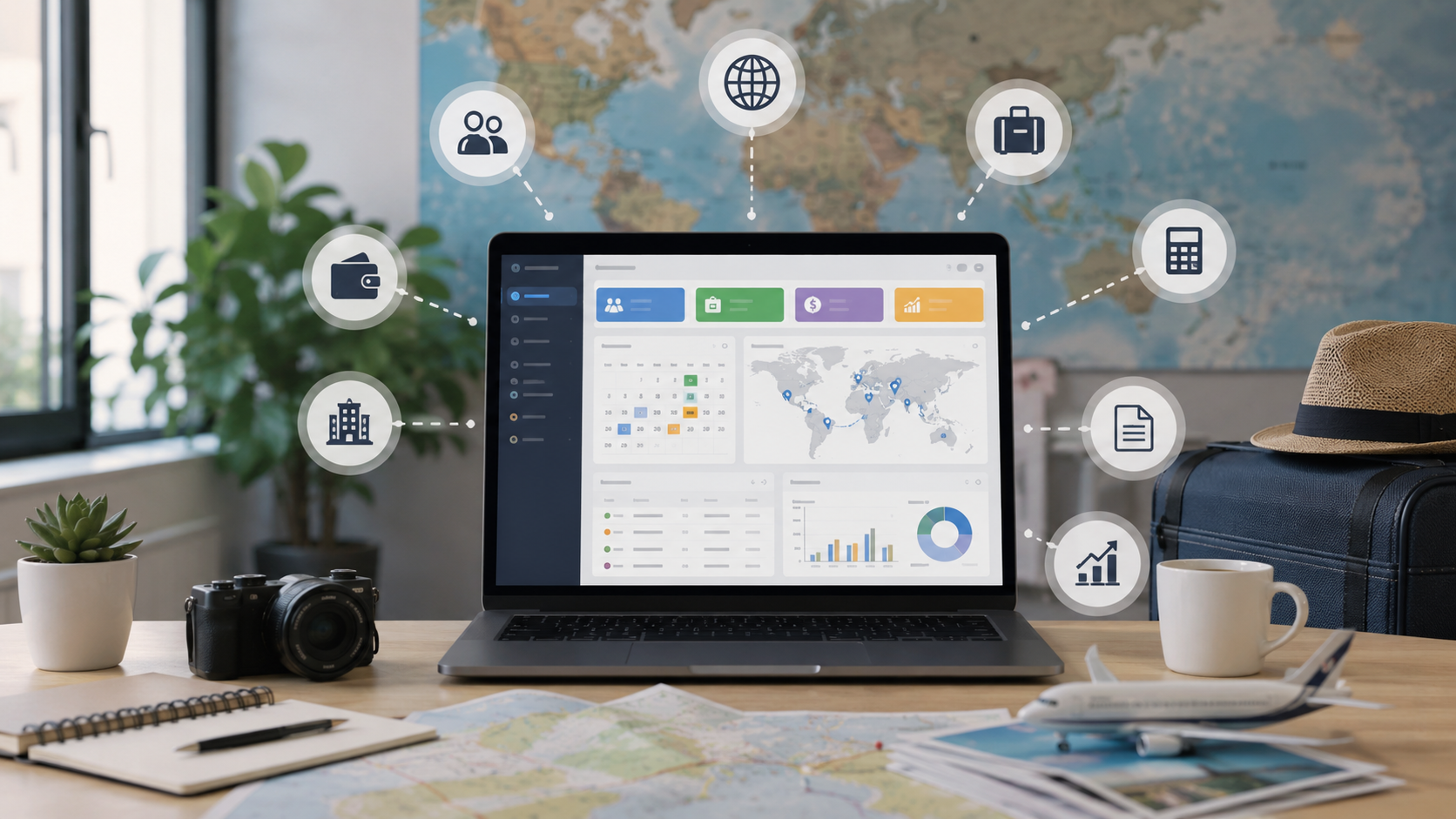
A platform like MOGU makes it possible to keep bookings, travellers, payments, documentation and communications in a single environment.
Mistake 2: Managing participants manually
Manual tracking tends to work with small groups, but becomes inefficient as the number of travellers increases.
The main risks are:
- Duplicate data.
- Out-of-date information.
- Manual entry errors.
- Lack of traceability.
- Dependency on specific individuals.
Automating participant management significantly reduces these risks.
Mistake 3: Having no document control
Documentation is one of the most sensitive elements in any organised trip.
Passports, visas, insurance certificates, authorisation forms and tickets must be accessible and up to date.
The absence of document control causes incidents that affect both the agency and the traveller.
Centralised management makes it easier to collect, validate and retrieve all documentation.
Mistake 4: Not automating communication with travellers
Many teams spend a significant part of their day answering the same questions repeatedly.
The most frequent queries tend to relate to:
- Outstanding payments.
- Schedules.
- Documentation.
- Itinerary changes.
- Booking confirmations.
Automation allows all participants to be kept consistently informed while reducing the administrative burden.
Mistake 5: Managing payment collection manually
Payments are one of the most critical processes in group travel.
When follow-up is done manually, problems arise such as:
- Unidentified payments.
- Forgotten payment deadlines.
- Reconciliation errors.
- Lack of financial visibility.
Automating payment collection provides a real-time view of the financial status of every group.
With MOGU it is possible to manage bookings and payments from a single platform, reducing time spent on administrative tasks.
Mistake 6: Not tracking changes and incidents
Every group trip is exposed to modifications.
Room changes, flight amendments, partial cancellations and participant adjustments can all occur.
When these changes are not recorded in a structured way, the risk of operational errors increases.
Traceability is essential to maintaining control.
Mistake 7: Building proposals from scratch every time
Many agencies still prepare quotes manually for each group.
This practice slows down the sales process and increases the likelihood of errors.
Standardising proposals and reusing content makes it possible to:
- Respond more quickly.
- Maintain commercial consistency.
- Reduce errors.
- Increase productivity.
Mistake 8: Not measuring management indicators
Continuous improvement requires objective metrics.
Without indicators, it is impossible to identify bottlenecks or measure real profitability.
Key indicators for managing group trips
The most efficient agencies tend to monitor indicators related to productivity, profitability and client experience.
- Average management time per group.
- Completed payment collection rate.
- Percentage of validated documentation.
- Number of incidents per traveller.
- Average response time.
- Operating margin per group.
- Proposal conversion rate.
- Percentage of returning travellers.
These indicators allow decisions to be made based on data rather than perception.
Manual management versus digitalised management
Characteristics of manual management
- Scattered information.
- Higher risk of errors.
- Limited financial tracking.
- Dependency on specific individuals.
- Difficulty scaling.
Characteristics of digitalised management
- Centralised information.
- Automated processes.
- Greater traceability.
- Real-time financial control.
- Operational scalability.
The difference between the two models is typically reflected directly in the agency's profitability and capacity for growth.
How to audit group travel management in your agency
Before optimising processes, it is worth identifying current weak points.
An initial diagnosis can be carried out by answering the following questions:
- Is all information centralised?
- Are payments tracked automatically?
- Do travellers receive automated communications?
- Is documentation organised?
- Are operational indicators defined?
- Can several groups be managed simultaneously without increasing headcount?
The more negative answers there are, the greater the potential for operational improvement.
How MOGU helps avoid the most common group travel mistakes
MOGU has been designed specifically for travel agencies that need to manage complex processes efficiently.
The platform makes it possible to bring together in a single environment:
- Commercial proposals.
- Bookings.
- Payments.
- Documentation.
- Traveller communication.
- Operational follow-up.
- Digital client experience.
This integration eliminates a large part of the problems caused by fragmented tools and facilitates the agency's scalability.
Conclusion
Group trips can become one of the most profitable lines of business for an agency when operations are correctly structured.
Most mistakes arise from a lack of control, an excess of manual tasks and the absence of scalable processes.
Centralising information, automating communications, managing payment collection and measuring indicators are the fundamental pillars for reducing incidents and increasing profitability.
Specialist tools such as MOGU make it possible to turn complex management into a more efficient, traceable and growth-ready system.
Frequently asked questions about group travel mistakes
What is the most common mistake in group travel?
Scattered information across multiple tools is usually the most frequent problem and the root cause of many operational errors.
How can group travel profitability be improved?
By reducing manual tasks, automating processes and improving the financial control of each operation.
What software helps manage group tourism?
Specialist platforms such as MOGU allow bookings, payments, travellers and documentation to be managed from a single environment.
Why is it important to automate payment collection?
Because it improves financial control, reduces administrative errors and provides a real-time view of the status of each booking.
What indicators should an agency specialising in groups measure?
Management time, profitability, completed payments, incidents, commercial conversion and traveller satisfaction.
More from the MOGU blog
Keep reading
.png)
The future of AI in travel agencies: what's coming in 2026
Discover how AI will transform travel agencies in 2026 and how to adapt so you can automate, sell more, and stay ahead of the curve
2026-06-16

How to Improve the Payment Experience at Your Travel Agency
Improve payment management at your travel agency with automation, payment links and a billing CRM that reduces friction and increases conversions.
2026-05-29
Software for Tour Operators and DMCs That Want to Scale Without Chaos
Optimize your agency operations with the best software for tour operators and DMCs. Scale without errors, duplicates, or friction
2026-05-20
Curious about MOGU?
See it in action — no strings attached