
How to get more last-minute bookings
 Written byMOGU Team
Last-minute bookings are demand worth working on. In 2025 Expedia Group saw a 20% increase in the share of searches made between 0 and 13 days before the trip, a figure that reached 30% for international searches. In EMEA, short-term planning also grew by 30%.
For travel professionals, however, capturing this demand comes with an obvious difficulty: there is much less time to react.
When departure is only a few days away, you cannot afford to spend hours preparing a proposal that then turns out to have no availability, chasing information across different tools or dragging out the booking process unnecessarily.
The opportunity lies in working on demand with a real chance of converting, and having an operation ready to move from proposal to booking quickly.
Start with the clients most likely to book
If you have a departure coming up, your first instinct is probably to spread the word as widely as possible. But when time is against you, segmenting is usually more effective than messaging your whole database.
Review past enquiries, preferences and bookings, and look for real matches with the product you need to sell: dates, length, budget, departure airport, group make-up or type of experience.
Someone who recently asked about a four-night getaway may be a good fit for a similar departure. Someone who travelled with you three years ago, but with completely different needs, not necessarily.
Anyone who sells these opportunities knows that a last-minute campaign works best when the client quickly understands why that proposal might interest them.
Nor does the message need to tell the whole trip. It should let the reader see in a few seconds:
- What is on offer.
- When the trip takes place.
- The price and conditions.
- The next step to book.
The urgency has to be real. If a rate can be held until a specific date or only a certain number of places are left, say so. Creating artificial scarcity can do exactly the opposite of what we want: lose trust.
Work with product you can confirm quickly, and protect your margin
In a last-minute operation, knowing your product well stops being just an advantage.
You need to know which suppliers can respond quickly, which services are actually available, which ones need reconfirmation and how long you can hold the conditions.
If you regularly work with certain routes, tours or getaways, having a reusable base makes a big difference. Not because you should send the same proposal to everyone, but because it makes no sense to rebuild from scratch what you have already worked on and validated.
The MOGU library lets you save complete itineraries, days and content blocks to reuse in new proposals. MOGU AI can also help you adapt content or draft follow-up messages, always with a professional review before sending them.
In these campaigns it pays to check prices, schedules, availability and cancellation terms especially carefully. A description can stay valid for months; a rate may not stay valid for even a few hours.
Last minute does not necessarily mean a discount
This is another point any professional will recognise. When there are places left to sell, cutting the price can seem like the most direct solution. But before doing so, you should know exactly what margin is left after the discount.
The goal should not be to fill a place at any cost, but to turn available capacity into a profitable sale.
Sometimes adjusting the price will make sense. Other times you can rework the make-up of the product, or keep the price and strengthen the value of the proposal.
The decision has to start from the numbers, not simply from how close the departure is.
Keep the distance between proposal and booking to a minimum
When someone wants to travel within a few days, every extra step can become a chance to lose the sale.
The proposal should make it easy to understand the itinerary, the price, what is included, the conditions and what the client needs to do if they want to go ahead.
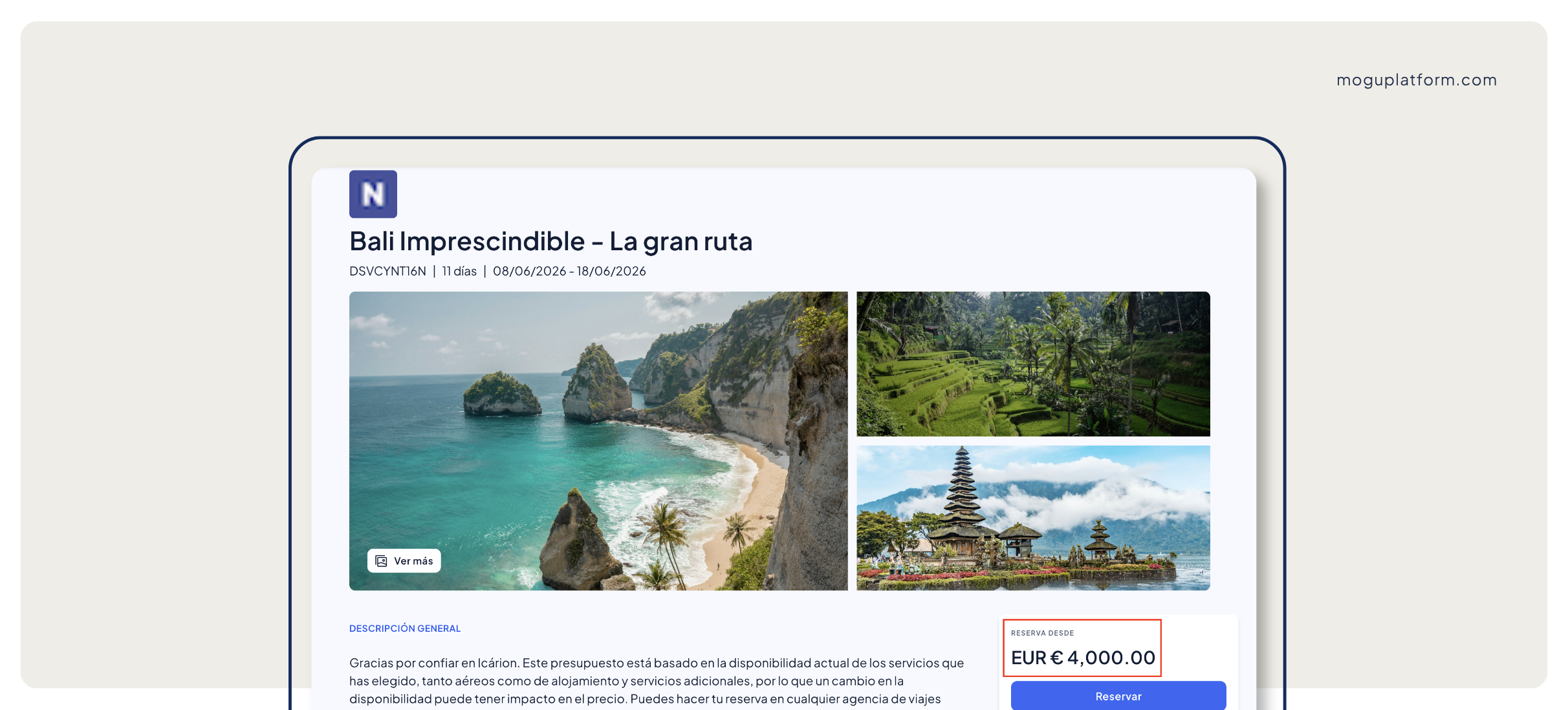
The MOGU proposal builder lets you bring together accommodation, activities, transport and maps in a proposal that can be shared directly through a link.
But what really matters in a last-minute operation happens afterwards.
If the client decides to book, the process has to be ready for them to do so.
MOGU lets you set up online bookings, forms and optional services, and handle payment within the process itself. If there are still elements to confirm, you can also work with a pre-booking without payment.
And when you need to collect an amount tied to an existing booking, you can generate a payment link and check its status later.
For the professional, this continuity is key. If the proposal lives in one place, the details arrive by email, the payment is checked in another tool and the booking is tracked in an external spreadsheet, the supposed agility of a last-minute campaign quickly disappears.
Speed matters, but control matters more
Getting last-minute bookings is not simply a matter of publishing an offer and waiting.
Three things make the difference: choosing carefully who you target, working with product you can confirm with confidence and removing obstacles between interest and booking.
And after each campaign, it is worth reviewing what happened: which proposals got a response, which ended in a booking, what margin they left and why the other opportunities were lost.
That information makes each next last-minute action less improvised.
MOGU brings proposals, reusable content, bookings and payments together in one place, with native artificial intelligence to support certain preparation and follow-up tasks.
Book a demo and discover how to speed up your next proposals and bookings.

More from the MOGU blog
Keep reading

10 group travel management mistakes that eat into your agency's margin
The 10 operational mistakes that cost an agency the most time, control and margin on group trips, and how to avoid them with a connected process.
2026-10-06

MOGU Travel CRM: sales and trip management, now connected and powered by AI
Discover MOGU Travel CRM for travel agencies: centralize contacts, opportunities and trips, and automate your sales pipeline with AI.
2026-09-29
.png)
Common Group Travel Mistakes and How to Avoid Them
Discover the most common mistakes when organising group trips and learn how to improve profitability, payment collection and agency operations.
2026-06-25
Curious about MOGU?
See it in action — no strings attached